


Page 195 - JobsPlus - Occupational Handbook
P. 195
• Work closely with the news team, photographers and editors
• Abide with privacy, contempt and defamation laws
Work environment
Journalists are typically engaged by publications or news agencies. Although part of the work is office-based, Journalists spend time out of the office meeting contacts and sources in person, investigating stories and carrying out other duties depending on the nature of their work, such as reporting on court cases.
Journalists generally work a 40 hour week but may be on call and work out of their scheduled hours in order to cover news events thoroughly.
Occupation data
Entry level education / special licences / warrants
To work as a Journalist, a minimum of an MQF Level 5 qualification is expected. Relevant study programmes include the following:
• Diploma in Journalism (University of Malta) (MQF Level 5)
• B.A. (Hons.) in Journalism offered jointly by the Tumas Fenech Foundation for Education in Journalism and the Institute for Creative Arts (MCAST) (MQF Level 6)
For further details on specific entry requirements, it is advisable to consult the respective educational institution’s website.
Although a specialised qualification in Journalism is preferred, it can be noted that qualifications (at MQF Level 5 or above) in Literacy, Communications and/or International Relations are often accepted as sufficient for a Journalist role. This would vary according to the type of journalism as well as the employer.
Qualifications awarded by foreign bodies need to be recognised or pegged with a particular MQF Level by the MQRIC office within NCFHE
For related training offered by other educational institutions, it is advisable to consult the list of accredited courses on the NCFHE website.
A valid driving licence is typically required for such a role.
On-the-job training is usually offered by the employer.
Knowledge and skills
Journalists are expected to have:
• The ability to write factual, concise and interesting reports
• Interviewing and reporting skills (with specialised knowledge on questioning, probing, etc.)
• The ability to grasp complex issues and explain them in simple, concise language for the relevant audience (where applicable)
• Knowledge of national journalistic law (including libel, defamation, privacy and copyright)
• Sufficient and up-to-date understanding of local, national and international affairs
• Note taking abilities using a variety of methods
• Research skills
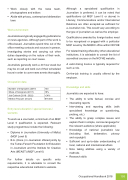
 Number of employees (2017)
   103
  Share of foreigners (2017)
    18%
  Job Outlook (2018 - 2022)
  +34%
  Median Pay (per annum)
    €19,000
 Occupational Handbook 2018
 195


